
uPVC vs Aluminium Windows: Which One Is Actually Better for Indian Homes?
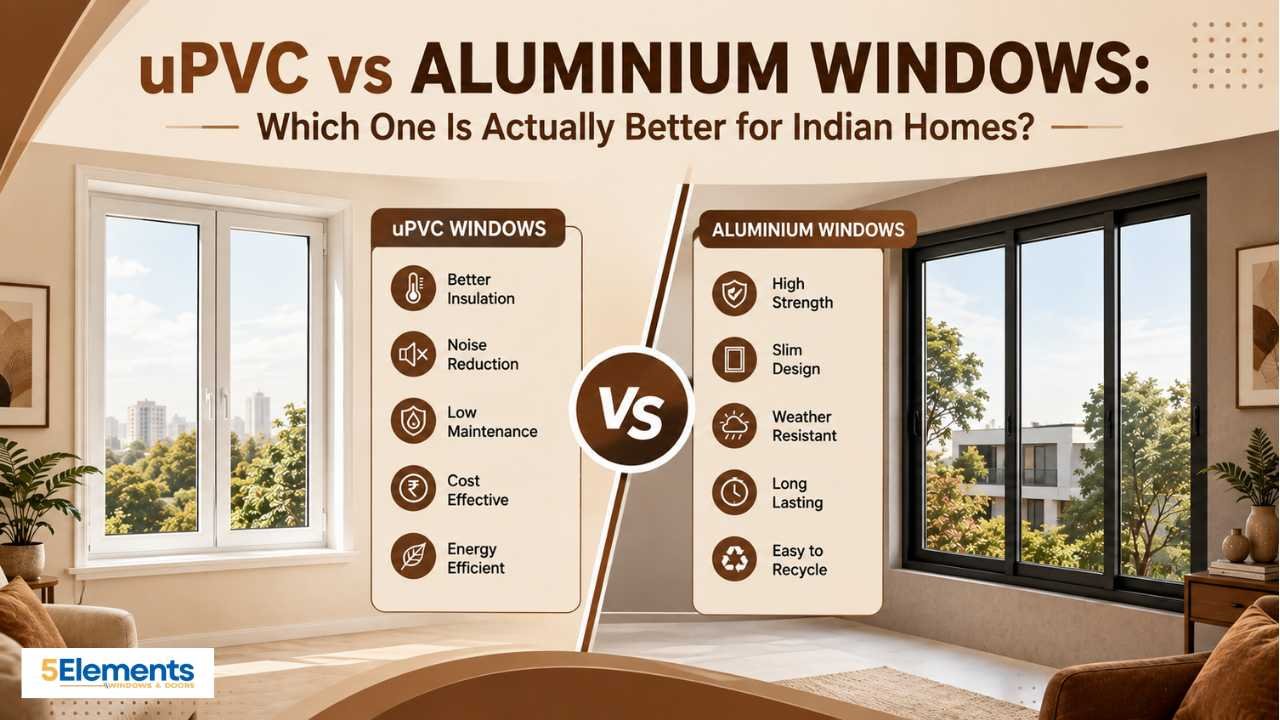
If you are building or renovating a home in India right now, you have probably already run into this question: uPVC vs aluminium windows – which one is better? Both materials show up in almost every window catalogue, and both come with strong claims from suppliers. At 5Elements, we install uPVC windows across Kerala every week, so we see first-hand what holds up in real Indian weather and what doesn’t.
This guide breaks down uPVC vs aluminium windows on cost, performance, and durability, so you can decide based on facts rather than sales pitches — including how different climate zones change the answer, and what to check before finalising a supplier.
uPVC vs Aluminium Windows Cost in India: What You will Actually Pay
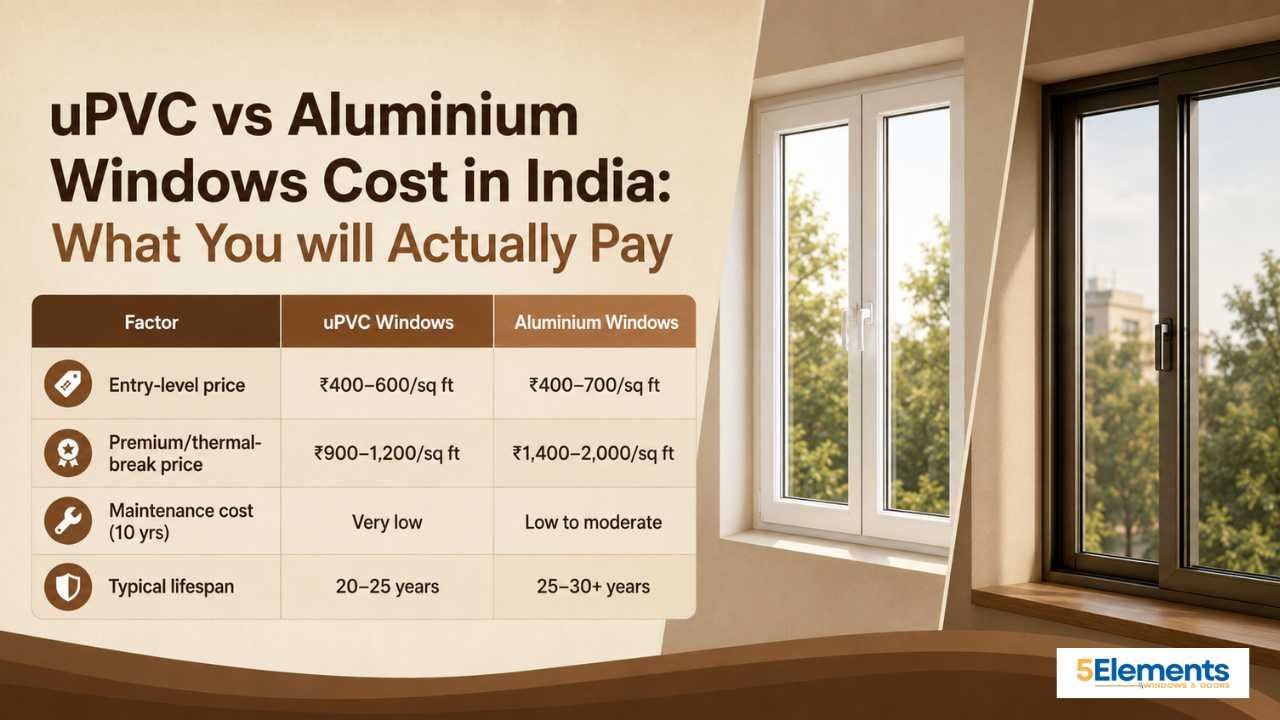
While comparing uPVC vs aluminium windows, cost is usually the first question homeowners ask, and it’s also where a lot of confusion starts, because “cost” means different things depending on the profile brand, glass type, and hardware used. As a broad range across the Indian market, uPVC windows typically fall between ₹400 and ₹1,200 per square foot, fully installed. Aluminium windows start around the same ₹400 mark for basic fabricated sections but can go up to ₹1,600–₹2,000 per square foot once you add thermal break technology, which is what stops aluminium from transferring outdoor heat straight into your room.
Glass matters as much as the frame. Whether you go with uPVC window designs or aluminium, the glass specification has a huge impact on both cost and performance. Single glazing is the cheapest option but offers the least insulation. Double glazing, with a sealed air gap between two panes, significantly improves both thermal and sound insulation and is now standard on most mid-to-premium projects in India.
Laminated glass adds a safety layer — it holds together if cracked — and is worth considering for ground-floor windows or homes in cyclone-prone coastal belts. When you’re comparing two quotes side by side, always check whether the glass type and thickness are identical. A cheaper quote is often cheaper because it specifies thinner or single-pane glass, not because the frame material itself is less expensive. A few things worth knowing before you compare quotes:
- Fabricated vs system windows matters more than the material. A basic fabricated aluminium window and a branded uPVC system window aren’t really comparable — which means when you look into uPVC vs aluminium windows, you’re paying for engineering, not just raw material.
- Glass is often 25–35% of your total window cost, regardless of frame material, so don’t judge a quote purely on the frame price.
- uPVC usually wins on long-term cost because maintenance is close to zero — no repainting, no anti-corrosion treatment, no repeated servicing. Aluminium can match uPVC’s upfront price at the basic level, but thermal-break aluminium (which you’ll want in most of India) pushes the price up considerably.
If your budget is fixed and you’re comparing — similar glass, similar hardware quality — uPVC will usually come out cheaper both to install and to own over the next decade.
City and project size affect the final number too –
A 2BHK apartment with standard-sized windows will land at a very different total than a villa with large sliding units or French windows. As a rough guide, a 2BHK with 8–10 windows in uPVC typically costs somewhere between ₹1.2 lakh and ₹2.5 lakh for the full window package, depending on profile brand and glass specification. Aluminium for the same project, once you add thermal break where needed, usually comes in 20–40% higher.
These are indicative numbers — always ask for a written, itemised quote rather than a single price-per-square-foot figure, since that number alone doesn’t tell you much about hardware quality, glass thickness, or the warranty on offer.
Don’t forget the hidden costs either –
With aluminium, budget for periodic servicing of hinges and rollers, and possibly recoating in coastal or high-pollution areas after several years. With uPVC, the ongoing cost is close to zero, but it’s still worth checking what warranty your supplier offers on the profile itself — a genuine UV-stabilised profile from a reputed brand should carry a warranty of at least 10 years.
uPVC Windows Advantages and Disadvantages
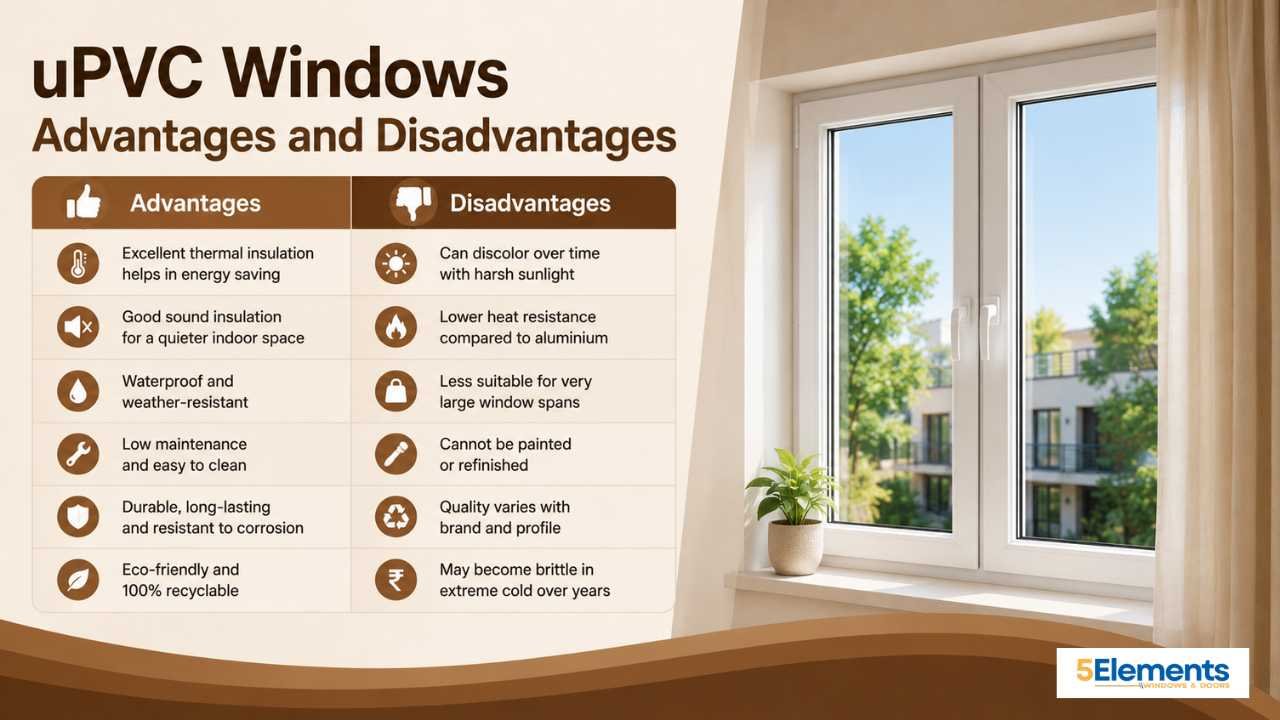
uPVC (unplasticised polyvinyl chloride) has become the default recommendation for most residential projects in India, but it isn’t perfect for every situation. To choose one from uPVC vs aluminium windows we need to understand both the advantages and disadvantages of uPvc first. Here’s an honest look at both sides.
Advantages
Some of the advantages of uPVC windows include:
- Thermal insulation – uPVC is a poor conductor of heat, so it keeps outdoor heat from entering your home. In hot Indian summers, this can noticeably reduce how hard your AC has to work.
- Sound insulation – The multi-chambered profile design and tight seals cut down outside noise significantly — a real benefit if you live near a main road or in a busy neighbourhood.
- Weather and corrosion resistance – uPVC doesn’t rust, rot, or corrode. It handles monsoon humidity and coastal air well, which matters a lot in states like Kerala.
- Low maintenance – A damp cloth is usually all you need. There’s no repainting or protective coating required over the window’s lifetime.
- Steel-reinforced strength – Good uPVC systems use galvanised steel reinforcement inside the frame, which gives them structural strength despite being a plastic-based material.
Disadvantages
It is important to understand the disadvantages of uPVC windows while learning about uPVC vs aluminium windows.
- UV sensitivity over time. Lower-quality uPVC (with reduced titanium dioxide content) can yellow or become slightly brittle after many years of direct sun exposure. This is why profile quality matters — ask your supplier about UV stabilisation.
- Limited design flexibility for very large openings. uPVC frames are bulkier than aluminium, so for floor-to-ceiling glass walls or very wide openings, aluminium is usually the better structural choice.
- Fewer colour and finish options compared to aluminium, though woodgrain and laminated finishes have improved a lot in recent years.
For a typical apartment, villa, or independent house in India, the advantages tend to outweigh the drawbacks — especially if you’re buying from a supplier who uses quality-tested profiles rather than the cheapest available material. Homeowners who’ve had a bad experience with uPVC almost always trace it back to one of two things: an unbranded, low-quality profile, or poor installation that left gaps around the frame. Neither of those is really a flaw in the material itself.
A Quick Note on Quality Differences -
Not all uPVC is the same. The profile’s wall thickness, the number of internal chambers, and the amount of titanium dioxide used all affect how well the window performs and ages. A cheap, thin-walled uPVC profile from an unbranded supplier can warp under heat or discolour within a few years — which is exactly the kind of experience that gives the whole material an unfairly bad reputation.
When you’re comparing quotes (uPVC vs aluminium windows), ask specifically about profile brand, chamber count (5- or 6-chamber profiles perform noticeably better than 3-chamber ones), and hardware brand, not just the price per square foot.
Aluminium Windows: Strength, Style and Where They Fall Short
Now, for the next session of uPVC vs aluminium windows, we need to look into details of aluminium. Aluminium has been used in Indian construction for decades, and it still holds a large share of the commercial window market for good reason.
Where Aluminium Performs Well
- Structural strength. Aluminium can support large glass panels without sagging, which makes it the go-to choice for high-rise buildings, storefronts, and floor-to-ceiling windows.
- Slim frames, more glass. Because aluminium is strong even in thin sections, you get slimmer sightlines and more visible glass area — a look that suits modern, minimalist architecture.
- Design range. Aluminium takes powder coating and anodising well, so you get a much wider choice of colours and finishes than uPVC.
- Recyclability. Aluminium can be melted down and reused with minimal quality loss, which appeals to homeowners thinking about environmental impact. uPVC is technically recyclable too, but the process is less established in India, so most old uPVC frames end up in landfill rather than getting reprocessed.
Where Aluminium Falls Short
- Heat conduction – Aluminium is a natural conductor of heat. Without thermal break technology, aluminium window frames transfer outdoor heat inside quickly — a real problem in most Indian cities for a large part of the year.
- Corrosion in humid or coastal zones – Untreated or poorly coated aluminium can oxidise over time, especially near the coast. Anodised or powder-coated finishes help, but they add to the cost and need occasional upkeep.
- Cost jump for thermal-break variants – The aluminium that actually competes with uPVC on insulation costs considerably more than basic fabricated aluminium, which is why some homeowners end up disappointed after choosing the cheaper, non-thermal-break option and then dealing with a hot room for half the year.
- Noise insulation depends heavily on the gasket and glazing used — a plain aluminium window without proper sealing won’t block sound as well as a well-built uPVC system.
So while comparing uPVC vs aluminium windows, Aluminium is a strong choice when your priority is large glass areas, a sleek modern look, or a commercial-grade build — but for residential comfort in Indian conditions, it usually needs the (costlier) thermal-break upgrade to match what uPVC delivers by default.
Where aluminium genuinely makes sense in India is large-format residential projects — think penthouses with floor-to-ceiling glazing, or homes designed around an open, glass-heavy facade. In these cases, uPVC’s bulkier frame profile simply can’t achieve the same slim sightlines, and the extra cost of thermal-break aluminium is usually justified by the design outcome. For a standard bedroom or living room window in a typical home, though, that same investment doesn’t pay off the way it does on a full glass wall.
Best Window Material for Indian Homes: Our Final Take on uPVC vs Aluminium Windows
Honestly there is no single “better” material while comparing uPVC vs aluminium windows — it depends on the building type, your climate zone, and what you’re optimising for.
By climate zone, here's how the two generally compare:
- Coastal areas (Kerala, coastal Karnataka, Mumbai, Chennai, Goa): High humidity and salt-laden air are tough on untreated metal. uPVC’s non-corrosive nature gives it a clear edge here, and this is exactly why it’s become the standard choice for homes along Kerala’s coastline.
- Hot, dry regions (Rajasthan, parts of Gujarat, interior Maharashtra): Intense, prolonged sun exposure tests UV stability on both materials. Quality uPVC with proper UV stabilisers holds up well; aluminium needs a good anodised or powder-coated finish to avoid fading and heat buildup.
- Northern winters (Delhi NCR, Punjab, parts of UP): Insulation matters on both ends of the temperature scale, not just summer heat. uPVC’s insulating properties help keep interiors warmer in winter as well as cooler in summer, which is a year-round advantage in this zone.
- Noisy metro environments (Mumbai, Bengaluru, Delhi): Traffic and construction noise are a daily reality. uPVC’s tighter seals and multi-chamber profile generally outperform standard aluminium here, unless the aluminium is fitted with acoustic glazing and premium gaskets.
uPVC vs Aluminium Windows - Choose uPVC if:
- You live in a hot, humid, or coastal region (most of India falls into this category)
- You want low running costs and near-zero maintenance
- Noise from traffic or neighbours is a concern
- You’re building a standard home, apartment, or villa
uPVC vs Aluminium Windows - Choose Aluminium if:
- You’re working on a commercial project, high-rise, or a home with large glass frontage
- Slim sightlines and a contemporary look matter more to you than insulation
- You’re prepared to pay extra for thermal-break profiles to get comfortable indoor temperatures
- Your project involves a lot of glass and structural spanning that a bulkier uPVC frame can’t support as cleanly
While comparing uPVC vs aluminium windows – for the vast majority of residential projects we work on across Kerala — from Thrissur to Kochi to Trivandrum — uPVC ends up being the more practical choice once you factor in the region’s heat, humidity, and monsoon rain. It costs less to run over the years, needs almost no upkeep, and holds up well against the specific conditions Indian homes deal with. Aluminium still has a place, particularly for commercial spaces and architecturally driven designs where large glass panels are the priority.
If you’re unsure which fits your specific home from uPVC vs aluminium windows, it’s worth getting an on-site assessment rather than deciding from a brochure — factors like your home’s orientation, local climate, and noise exposure all affect which material will actually perform better for you.
What to Check Before You Finalise a Supplier
Whichever material you choose from uPVC vs aluminium windows, the installer matters almost as much as the product itself. A well-made profile fitted poorly will leak air, let in noise, and fail early — which is often what’s really behind a bad experience that gets blamed on the material. Before signing off on a quote, it’s worth checking a few basics:
- Ask for the profile brand and its warranty, not just a generic “premium uPVC” or “branded aluminium” claim. Reputed brands will have documentation you can verify.
- Confirm the chamber count for uPVC (5- or 6-chamber is preferable for insulation) and whether the aluminium is thermal-break or standard.
- Check hardware brand and multi-point locking — this affects both security and how well the window seals over time.
- Ask to see completed projects nearby, ideally a few years old, so you can see how the windows have actually aged in your local climate rather than relying on a showroom sample.
- Get the warranty in writing — covering the profile, the hardware, and the installation work separately, since these often carry different terms.
This is also where local experience counts. A supplier who has installed windows across your specific region for several years will know which profile thickness and glass combination actually holds up against your local weather, rather than offering a one-size-fits-all recommendation. It’s a good idea to ask direct questions during your site visit — how long they’ve been installing in your area, which profile brands they typically use, and whether they can show you a project of similar size and age to yours.
Conclusion
Choosing between uPVC vs aluminium windows isn’t about which material is “better” in general — it’s about which one fits your home, budget, and climate. uPVC wins on insulation, maintenance, noise control, and long-term cost, making it the stronger choice for most Indian homes, particularly in hot and humid regions. Aluminium still holds its ground where large glass panels, slim frames, or a commercial-grade build are the priority, provided you’re willing to invest in thermal-break technology to offset its heat conduction.
If you’re renovating or building in Kerala and want windows suited to local weather, reach out to the 5Elements team — we can walk you through real options and pricing based on your specific home, by comparing uPVC vs aluminium windows in detail – not just a generic comparison chart.
FAQ
1. What is the main difference between uPVC windows and aluminium windows?
uPVC windows provides better insulation and aluminium windows are more stronger.
2. Which one is better for Indian homes: uPVC windows and aluminium windows?
uPVC windows are typically more suitable to Indian climates.
3. What are uPVC windows made of?
uPVC is made of unplasticised polyvinyl chloride which is a tough polymer.
4. Which type of window offers more investment return?
uPVC windows can provide the best value long-term for houses.
5. Is uPVC superior to aluminium in homes?
Yes, uPVC will be the preferred choice for the residential buildings.